PCOS Diet at 20 vs 35: Age-Specific Indian Diet Plan | Dietician Ankita Sehgal
Are you 20 or 35 with PCOS? Your body is different — so your diet must be too. India's trusted dietician Ankita Sehgal explains the exact PCOS diet changes you need at every age, using simple Indian foods.
PCOS
3/6/20267 min read
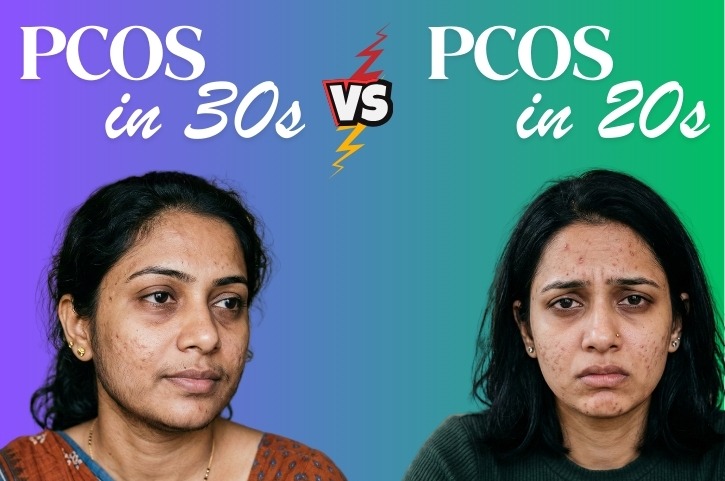
PCOS at 20 vs. PCOS at 35 — Why Your Diet Needs to Be Completely Different
By Dietician Ankita Gupta Sehgal
Rated as One of the Best Dietician in Delhi for PCOS & Women's Health | 16+ Years of Clinical Experience
If you've been diagnosed with PCOS, you may have noticed something frustrating: the advice your friend followed at 22 is not working for you at 34. Or the diet that helped you manage PCOS symptoms in your 20s suddenly stopped working once you crossed 30.
You are not imagining it. PCOS is a condition that changes with your body - and your body changes dramatically between your 20s and your 30s. As a dietician with over 16 years of experience treating PCOS in women across all age groups, I can tell you with complete confidence: a 20-year-old with PCOS and a 35-year-old with PCOS need two fundamentally different diet plans.
In this blog, I am going to break down exactly what changes - and precisely what to eat at each stage - using simple, practical Indian home food. No supplements, no exotic superfoods. Just the right food at the right time for your body.
First: What Is PCOS and Why Does Age Matter?
PCOS (Polycystic Ovary Syndrome) is one of the most common hormonal disorders in Indian women, affecting approximately 1 in 5 women of reproductive age. It is characterised by irregular periods, elevated androgens (male hormones), insulin resistance, and in many cases, the appearance of small cysts on the ovaries.
But here is what most people - and even many doctors - don't explain clearly: PCOS is not a static condition. Your hormone profile at 20 is very different from your hormone profile at 35. Your metabolism changes. Your stress response changes. Your fertility priorities change. Your risk of complications like diabetes and thyroid disorders increases. And therefore, your diet must change too.
PCOS in Your 20s: What's Happening in Your Body
In your early 20s, PCOS tends to show up primarily as:
• Irregular or missed periods
• Acne and unwanted facial hair (due to high androgens)
• Difficulty losing weight despite eating 'normally'
• Blood sugar swings and sugar cravings
• Anxiety, mood swings, and fatigue
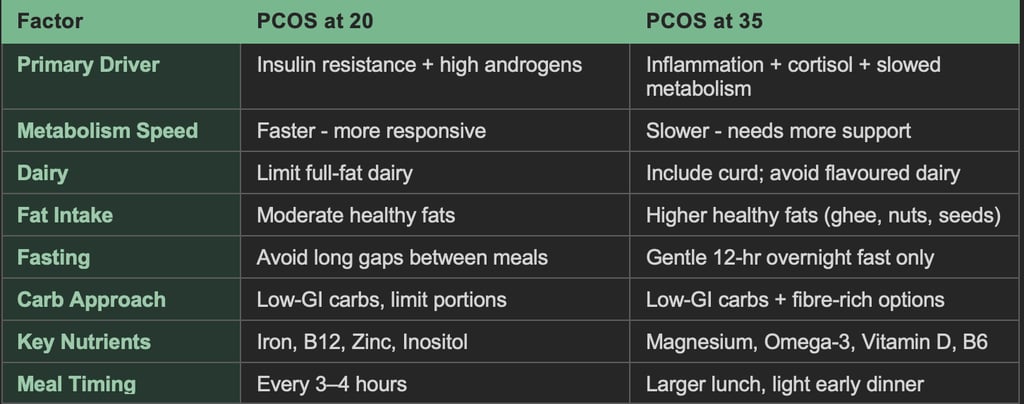
At this age, insulin resistance is usually the primary driver. Your cells are not responding well to insulin, which causes your pancreas to overproduce it - and this excess insulin then signals your ovaries to produce more androgens. The result is a hormonal cascade that disrupts your entire cycle.
The good news? At 20, your body is still highly responsive to dietary changes. Even small, consistent shifts in what you eat can create significant hormonal improvements within 8–12 weeks.
The PCOS Diet for Women in Their 20s: Key Principles
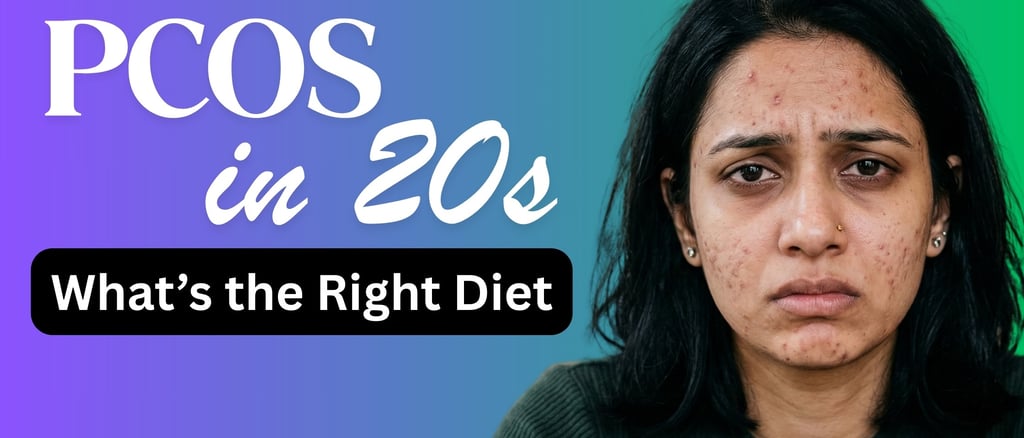
At this stage, your primary dietary goal is to reduce insulin spikes and lower androgen levels through food.
A breakfast rich in protein - moong dal chilla, besan cheela with vegetables, or eggs - prevents the morning insulin spike that sets your hormones off for the rest of the day.
Replace white rice with small portions of hand-pounded rice or millets like jowar and bajra. Roti made from whole wheat or multigrain flour is far better than maida-based breads.
Skipping meals worsens insulin resistance. At 20, your metabolism can recover quickly - but only if you feed it consistently.
Flaxseeds (alsi), spearmint tea, and fenugreek (methi) are powerful natural androgen-blockers. Add 1 tablespoon of ground flaxseed to your dal or roti dough daily.
For many young women with PCOS, high-fat dairy can worsen androgen levels and acne. Try reducing full-fat milk and paneer for 4–6 weeks and observe the difference.
Young women with irregular periods often develop anaemia. Include rajma, chana, and green leafy vegetables like methi, palak, and bathua regularly.
Sample Day Plate for PCOS at 20: Breakfast: Moong dal chilla with green chutney | Lunch: 2 multigrain rotis + rajma curry + cucumber raita | Snack: A handful of roasted chana + spearmint tea | Dinner: Khichdi with ghee + palak sabzi
PCOS in Your 30s: What Changes in Your Body
By the time you reach your late 20s and enter your 30s, PCOS starts behaving differently. Several important shifts happen:
You burn fewer calories at rest, making weight gain easier and weight loss harder - even on the same diet that worked at 22.
Most women in their 30s carry more lifestyle stress - career, marriage, children, ageing parents. Cortisol (the stress hormone) worsens insulin resistance and directly disrupts ovulation.
PCOS and thyroid disorders often co-exist, and this overlap becomes more prominent in the 30s. Unmanaged thyroid function makes PCOS symptoms significantly worse.
Many women in their 30s are thinking about conception. Diet for PCOS in this phase must actively support egg quality and uterine health, not just symptom management.
Chronic low-grade inflammation - worsened by poor sleep, stress, and processed food - becomes a bigger driver of PCOS in this decade than in the 20s.
The PCOS Diet for Women in Their 30s: Key Principles
At this stage, your diet needs to work harder and smarter. It is not enough to simply avoid bad foods - you need to actively support your metabolism, adrenal health, and hormonal balance simultaneously.
The core of your diet must be anti-inflammatory. This means turmeric in your dal and sabzi every day, omega-3-rich foods like walnuts and flaxseeds, and limiting refined oils in favour of ghee and cold-pressed mustard oil.
Healthy fats from ghee support the production of reproductive hormones. Women in their 30s who eliminate fat from their diet often see a worsening of their PCOS symptoms. 1–2 teaspoons of good desi ghee per day is ideal.
Magnesium is the mineral most depleted by stress - and it is essential for insulin sensitivity and healthy ovulation. Include almonds, pumpkin seeds (kaddu ke beej), and dark green leafy vegetables daily.
Gut health and hormonal balance are directly connected. Women in their 30s with PCOS often have gut inflammation that disrupts oestrogen metabolism. Add homemade curd (not flavoured yoghurt), kanji, and fermented foods to your diet.
Eating your largest meal at lunch (12–2 PM) and a lighter dinner by 7:30 PM helps regulate cortisol rhythm, which in turn supports progesterone production and regular cycles.
Intermittent fasting, which is trendy right now, can worsen cortisol levels and increase androgen production in women with PCOS in their 30s. A better approach is a consistent 12-hour overnight fast (e.g., 8 PM to 8 AM) rather than aggressive 16–18 hour fasts.
Sample Day Plate for PCOS at 35: Breakfast: Vegetable poha with a sprinkle of seeds + turmeric milk | Lunch: 2 rotis + dal tadka with ghee + lauki sabzi + curd | Snack: 4–5 walnuts + 1 small seasonal fruit | Dinner (before 7:30 PM): Moong dal soup + 1 roti + stir-fried vegetables
The Key Differences at a Glance
What Stays the Same at Every Age
While much changes between your 20s and 30s, some PCOS diet principles remain constant no matter how old you are:
Home-cooked Indian food will always outperform packaged 'health' foods
No supplement will replace a consistent, balanced diet
Movement matters - even a 30-minute walk after dinner significantly improves insulin sensitivity
Consistency across 8–12 weeks, not perfection in one week, is what creates lasting hormonal change
Your plan must be personalised to your blood reports, lifestyle, and food preferences - not copied from a friend or Instagram
A Word from My Clinic: Real Women, Real Results
Over 16 years and thousands of consultations, I have seen one pattern consistently: women who try to follow a generic PCOS diet plan - without considering their age, their stage of PCOS, their thyroid status, and their gut health - struggle. But women who get a plan tailored specifically to their body and their decade of life? They see results within weeks.
One of my clients - a 28-year-old IT professional from Delhi - reversed her PCOS symptoms in 4 months eating dal, roti, and sabzi every single day. Another client, a 37-year-old mother of one based in the UAE, regularised her periods for the first time in years after we shifted her focus from calorie restriction to cortisol management and anti-inflammatory eating.
The food was similar. The strategy was completely different. That is the power of age-specific PCOS nutrition.
Frequently Asked Questions
Q: Can PCOS be reversed through diet alone?
A: Diet is the most powerful tool for managing PCOS, and many women experience complete symptom reversal - regular cycles, clear skin, healthy weight - through dietary and lifestyle changes alone. However, some women may also need medical support depending on the severity of their condition. Always consult a qualified dietician and gynaecologist together.
Q: Is the PCOS diet different for vegetarians and non-vegetarians?
A: Yes, there are some differences, particularly around protein sources and omega-3 intake. However, Indian vegetarian cuisine is exceptionally well-suited for PCOS management - dal, legumes, paneer (in moderation), curd, seeds, and nuts provide everything your hormones need.
Q: I have both PCOS and thyroid. Do I need a special diet?
A: Yes - managing both conditions simultaneously requires a carefully designed plan that avoids foods that interfere with thyroid medication absorption while also supporting insulin sensitivity and hormone balance. This is one of my specialisations. A combined PCOS-thyroid diet plan is very different from a standard PCOS plan.
Q: How soon will I see results from an age-specific PCOS diet?
A: Most of my clients notice significant improvements in energy, digestion, and skin within 4–6 weeks. Cycle regularisation typically occurs between 8–16 weeks depending on age, severity, and consistency. Weight changes vary but are sustainable when they happen.
Q: I am in my 40s - is it too late to manage PCOS through diet?
A: Absolutely not. While PCOS symptoms naturally shift as women approach perimenopause, dietary support remains essential and effective throughout your 40s. The focus shifts further toward cardiovascular health, bone density, and managing the metabolic changes of this phase.
Ready to Get Your Age-Specific PCOS Diet Plan?
Book a personalised consultation with Dietician Ankita Gupta Sehgal
📞 +91-9873974659 | 🌐 www.ankitasehgal.com | 📧 info@nutritionmatters.co.in
16+ Years of Experience | Simple Indian Home Food | 95% Client Success Rate
Have a question?
Contact
Dietician Ankita Gupta Sehgal is one of India's leading dieticians specialising in PCOS reversal, sustainable weight loss, thyroid management, gut health, and women's hormonal nutrition. Based in Delhi with 16+ years of clinical experience, she has helped thousands of women across India, USA, UK, UAE, and Canada transform their health using personalised, science-backed Indian diet plans - no crash diets, no supplements, just real food.
info@nutritionmatters.co.in
+91-9873974659
© 2025. All rights reserved.
Call