Eating Right But Not Losing Weight? 3 Signs It’s Your Hormones, Not Your Willpower
Eating right but not losing weight? It might be Insulin Resistance, Cortisol, or Thyroid issues. Learn the 3 signs your weight loss struggle is hormonal.
3 min read
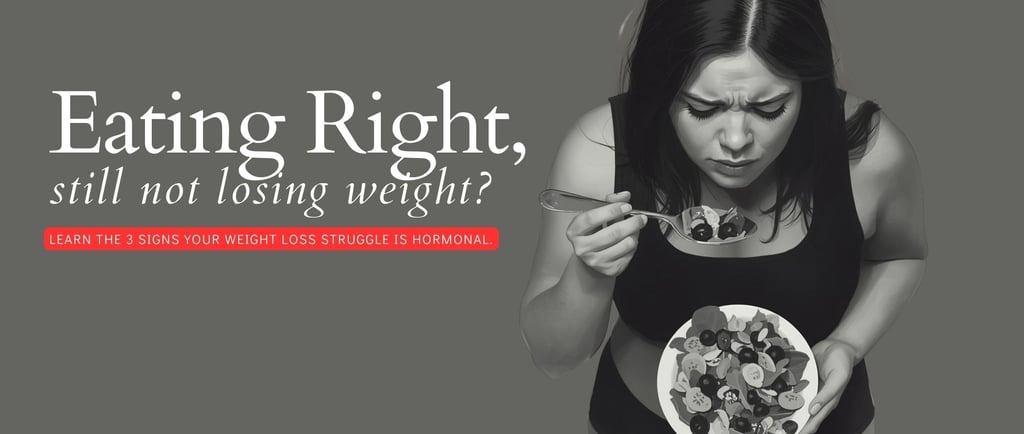
"I’m doing everything right. Why isn't the scale moving?"
I can hear the frustration in your voice when you say this. You are tracking your calories. You’ve swapped fried snacks for makhanas. You are walking 10,000 steps. You are drinking the water.
And yet, for the last three weeks, the weight hasn't budged. Or worse, it’s creeping up.
Standard diet advice will tell you that you are "cheating" or that you just need to eat even less and exercise even more. I am here to tell you to stop.
If you are genuinely putting in the effort and seeing zero results, the problem isn't your willpower. The problem is your biology.
Weight loss is often sold as a simple math equation: Calories In < Calories Out = Fat Loss. But for women dealing with PCOS, Thyroid imbalances, or high stress, weight loss is actually a chemistry equation. If your chemical messengers (hormones) are misfiring, your body will fight to hold onto every gram of fat to survive.
Here are 3 clear signs that your weight loss plateau is hormonal, and how we can fix it.
1. You Are Tired All The Time (Even After Sleeping)
The Hormones: Cortisol & Thyroid
Do you wake up feeling unrefreshed? Do you need two cups of chai or coffee just to function in the morning? Do you get a "second wind" of energy at 11 PM when you should be sleeping?
This is a classic sign of Adrenal Dysfunction and high Cortisol.
When you are chronically stressed (or over-exercising and under-eating), your body pumps out Cortisol. High Cortisol does two things:
It breaks down muscle tissue (lowering your metabolism).
It specifically stores fat around the midsection (belly fat) as a survival mechanism.
The Fix: If this is you, "pushing harder" in the gym will actually make you gain weight. You don't need more cardio; you need more sleep, magnesium, and stress-management techniques to lower cortisol so your body feels safe enough to burn fat.
2. You Crave Sugar Immediately After a Meal
The Hormones: Insulin
Imagine this: You just finished a healthy lunch. You are physically full. But 20 minutes later, you are hunting for chocolate, a piece of mithai, or even a biscuit.
This isn't "greed." This is Insulin Resistance.
Insulin is the key that unlocks your cells to let energy (glucose) in. When you have Insulin Resistance (common in PCOS), that lock is jammed. Your cells are starving for energy because the fuel isn't getting in, so your brain screams "EAT SUGAR!" to get quick energy.
Meanwhile, because that energy didn't enter the cell, it floats in your blood and eventually gets stored as fat.
The Fix: We need to sensitize your cells. This means changing the order of your food (Fiber first!), focusing on protein at breakfast, and potentially using specific supplements to help manage blood sugar levels.
3. You Are Eating Very Little (1200 Calories or less)
The Mechanism: Metabolic Adaptation
This is the most painful one. I see women eating bird-sized portions—skipping dinner, surviving on soups/salads - and still not losing weight.
When you drastically cut calories for a long time, your body thinks there is a famine. To keep you alive, your thyroid down-regulates. It slows your heart rate, digestion, and heat production to save energy.
You might be eating 1200 calories, but your body has adapted to only burn 1000. You are technically "dieting," but biologically, you are in a surplus.
The Fix: We have to do something scary: Reverse Dieting. We slowly increase your food intake to signal safety to your thyroid, speeding your metabolism back up before we attempt weight loss again.
The Bottom Line: Heal the Chemistry First
If you see yourself in these signs, please stop cutting calories. You cannot starve a hormonal imbalance away.
Your body is not broken; it is trying to protect you. The goal is not to fight your body, but to work with it.
If it’s Cortisol, we focus on rest.
If it’s Insulin, we focus on blood sugar stability.
If it’s Thyroid, we focus on nourishment.
Are you ready to stop guessing and start healing? Let’s look at your blood work, understand your symptoms, and build a plan that fixes the root cause.
Have a question?
Feel free to share your queries or questions with Dietician Ankita Gupta Sehgal | Rated as one of the best dietician in Delhi NCR
Phone
+91-9873974659
info@nutritionmatters.co.in
Contact
Dietician Ankita Gupta Sehgal is one of India's leading dieticians specialising in PCOS reversal, sustainable weight loss, thyroid management, gut health, and women's hormonal nutrition. Based in Delhi with 16+ years of clinical experience, she has helped thousands of women across India, USA, UK, UAE, and Canada transform their health using personalised, science-backed Indian diet plans - no crash diets, no supplements, just real food.
info@nutritionmatters.co.in
+91-9873974659
© 2025. All rights reserved.
Call