Is Your "Timepass" Mungfali Sabotaging Your Weight Loss? The Truth About Peanuts in Winter
Love eating roasted peanuts in the winter sun? Find out if "Timepass Mungfali" is helping or hurting your health. We break the top 3 myths about peanuts and reveal the perfect portion size.
MYTH BREAKER
12/28/20253 min read
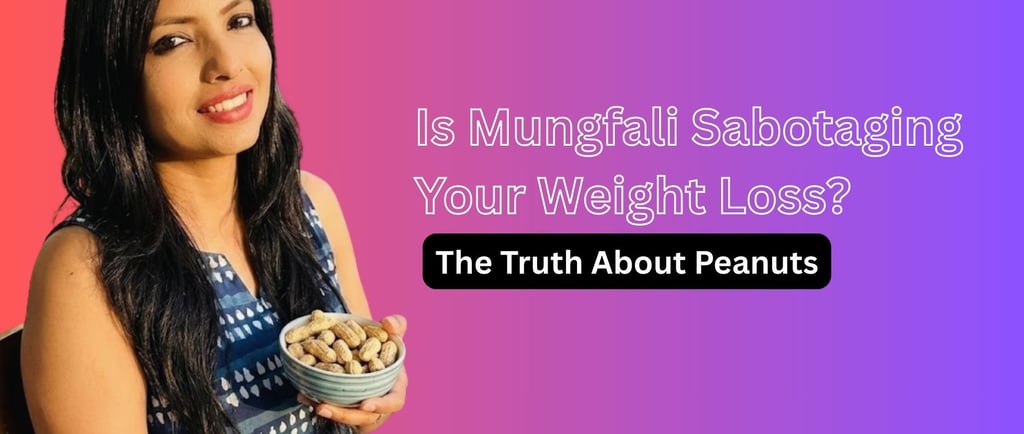
If you grew up in India, you know the ritual. The winter sun is out, the charpai is laid on the terrace, and the family gathers around a pile of roasted peanuts (Mungfali). It starts with one, then two, and before you know it, a mountain of empty shells sits in front of you.
It is the ultimate "Timepass" snack. But usually, after the satisfaction comes the guilt. "Will this make me gain weight?" "Is it bad for my cholesterol?" "Why do I feel bloated after eating them?"
As a clinical dietitian, I often see clients cutting out peanuts entirely in January because they think it's "junk food." This is a mistake. Peanuts are not the villain; they are misunderstood heroes.
Today, let’s peel back the shell and look at the science behind India’s favorite winter snack.
1. The "Poor Man’s Almond" is Actually a King
We often think expensive means healthy. We value Almonds and Walnuts (which are great), but we look down on the humble Peanut. The Nutritional Reality:
Protein Power: Peanuts actually contain more protein per gram (approx. 26g per 100g) than any other nut, including almonds!
Heart Health: They are rich in MUFA (Monounsaturated Fatty Acids) and PUFA. These are the "good fats" that help clean your arteries and lower bad cholesterol (LDL).
Essential Minerals: They are packed with Magnesium (great for muscle relaxation), Folate, and Vitamin E.
2. The Great Debate: To Peel or Not to Peel?
You mentioned you love unpeeled roasted peanuts. Keep doing that.
Many people obsessively rub the red skin off before eating. When you do that, you are rubbing away the medicine. The paper-thin red skin is rich in Resveratrol and phenolic acids.
What does Resveratrol do? It is a powerful antioxidant (the same one found in red grapes/wine) that fights inflammation, protects against heart disease, and may even have anti-aging properties.
Verdict: Eat the skin. It adds fiber and antioxidants.
3. Why Do We Crave Them in Winter?
Have you noticed you rarely crave peanuts in June? In winter, our metabolism changes. The body works harder to maintain its core temperature, and it naturally craves high-energy foods (fats) to fuel that heat.
Peanuts have a high thermogenic effect - they actually help keep the body warm from the inside. This is why Gajak and Chikki (Jaggery + Peanuts) are winter staples.
The combination of Jaggery (Iron) and Peanuts (Good Fats) is the perfect fuel for a cold day.
4. The "Weight Gain" Trap: The Math of Mindless Eating
Here is where the "Superfood" turns into a "Problem." Peanuts are technically legumes, but nutritionally, they act like fats. They are Calorie Dense.
1 Handful (approx. 30g): ~170 Calories. (This is a healthy snack).
100g (The typical paper packet): ~567 Calories.
Think about this: 567 calories is roughly equivalent to a full meal of 2 Rotis, Dal, and Sabzi. If you eat a full packet of peanuts as a "snack" between lunch and dinner, you have essentially eaten two lunches. This calorie surplus is what causes winter weight gain, not the peanut itself.
5. "Why do I feel gassy/bloated after eating peanuts?"
A common complaint! Since peanuts are legumes (cousins to beans/dal), they contain phytates and lectins, which can be hard to digest for some people, causing gas or acidity. The Fix:
Roast them well: Dry roasting breaks down some of these hard-to-digest compounds.
Don't drink water immediately: Drinking cold water right after eating oily nuts can sometimes trigger throat irritation or coughing. Wait 15-20 minutes.
Chew thoroughly: Digestion starts in the mouth. Since we eat them fast ("Timepass"), we often swallow chunks that ferment in the gut.
The Dietitian’s Verdict
Should you eat Mungfali this winter?
Yes, absolutely. But you must change how you eat them.
My 3 Golden Rules:
The "Closed Fist" Rule: Never eat directly from the big bag. Take one closed fistful, put it in a bowl, and put the big bag away.
Avoid the "Masala" Trap: Stick to dry roasted (in shell is best). Avoid the "Salted/Fried" packets sold in stores, as they are loaded with sodium which causes water retention and bloating.
The Diabetes Advantage: If you have diabetes, peanuts are excellent snacks because they have a low Glycemic Index (GI). They provide sustained energy without spiking your blood sugar.
Enjoy the winter sun, crack some shells, but remember: Mindful eating makes the difference between nourishment and punishment.
Contact
Dietician Ankita Gupta Sehgal is one of India's leading dieticians specialising in PCOS reversal, sustainable weight loss, thyroid management, gut health, and women's hormonal nutrition. Based in Delhi with 16+ years of clinical experience, she has helped thousands of women across India, USA, UK, UAE, and Canada transform their health using personalised, science-backed Indian diet plans - no crash diets, no supplements, just real food.
info@nutritionmatters.co.in
+91-9873974659
© 2025. All rights reserved.
Call